Would you like to switch to the accessible version of this site?

Go to accessible site Close modal window

Don't need the accessible version of this site?

Hide the accessibility button Close modal window
Accessibility View Close toolbar
Warner Center Pet Clinic

818-710-8528

Open mobile navigation
  • Home
  • Contact Us!
  • News
  • New Patient Center
    • Online Forms
    • What to Expect
    • Veterinary Resources
    • Payment Options
  • Medical Services
  • Meet Our Team
  • Reproductive Services
  • Canine Semen Services
  • Resources
  • Fun Videos
  • Community Content
    • Pet Health
      • Chronic Conditions
      • Digestive and Oral Health
      • Diseases and Viruses
      • Pests and Parasites
      • Orthopedics
    • Today's Veterinarian
    • Choosing Your Pet
      • Finding Your Pet
      • Cats
      • Dogs
      • Exotics
        • Amphibians
        • Birds
        • Reptiles
          • Lizards
          • Turtles
      • Small Mammals
        • Ferrets
        • Rabbits
        • Domesticated Animals
          • Prairie Dogs
        • Pocket Pets
          • Chinchillas
          • Guinea Pigs
          • Hamsters
          • Hedgehogs
          • Rats
      • Livestock
        • Cows
        • Donkeys, Horses & Mules
        • Goats
        • Pigs
        • Poultry
        • Sheep
    • Living With Your Pet
      • Bringing Your Pet Home
      • Children and Pets
      • Providing Care
      • Travel
      • Saying Goodbye
    • Newsletter Library
      • Cats
      • Tips for Pet Owners
      • Behavior & Training
      • Fleas & Parasites
      • Keeping Pets Healthy
      • Recognizing Illness
      • Nutrition & Food
      • Pet Dangers
      • Seasonal Topics
      • Visiting the Vet
      • Equine
      • Newsletter Archive
        • Fun with Pets
        • Unbelievable Pets
    • Video Newsroom
      • Health Topics
      • Technology and Science
      • Other Interests
    • Newsletter Library
    • Client Survey
    • Pets4Kids
  • Home >
  • Articles >
  • Newsletter Library >
  • Cats >
  • Keep Cats Moving and Grooving

Keep Cats Moving and Grooving

  • Created in Newsletter Library, Cats
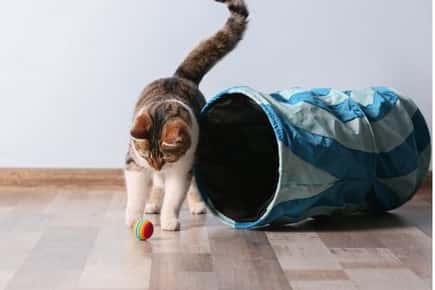
image of cat playing with a toy.

Keeping your cat active can help it burn calories and use muscles, tendons and ligaments that may often be seen catnapping. Burning calories is important for your cat. The more your cat moves and exercises, the more calories it will expend during the activity. Exercise will help to off-set the naps taken in your favorite chair and help to prevent obesity.

Exercise methods your doctor recommends will depend on your cat's current level of activity, health, age and medical condition. Indoor cats probably need more encouragement and support with exercise. You'll want to consider several methods to get your cat moving and grooving. Then, you'll want to shake up the sequence when you play.

Pet Weight Loss by veterinarian Jan Becker discusses pet exercise for owners of cats and dogs. "Cats on the other hand can be a bit harder to exercise," says Dr. Becker. Get your cats moving with cold laser lights flashed onto objects to interest them - but not in their eyes. Wiggle stuffed animals, move them sneakily to get your cat's interest and increase the attraction of pouncing, sneaking, hiding or batting at the soft toy.

  • Rope, shoelaces, yarn and ribbon - Cats typically love to play with long stringy items like yarn and ribbon, but Dr. Becker warns owners to beware of these. Owners must be vigilant of linear products or toys and use these only with supervision. The string can easily get caught or tangled with your cat's tongue inducing them to swallow it. Unfortunately, when this happens it can be "very serious or even fatal, if surgery is not performed to remove the object.
  • Flashlights - Everyone in your home has a flashlight for emergency use. Make sure your cat has one too. When playtime approaches, pick up your cat's flashlight, ruffle its coat and scratch its tummy. Move your arm behind you when the cat's awake and shine the flashlight beam two feet away from it. Your cat will see the light and want to pounce on it. As your cat moves toward the light, gently shift the light from place to place.
  • Bags - Paper grocery bags and gift bags make crinkly sounds that consistently get cats' attention.
  • Boxes - If your cat has a particular box it enjoys, encourage playtime with a small ball to bat from corner to corner of the box.
  • Straws - Tying a drinking straw into a knot and dropping it in your cat's line of view can start playtime. Your cat will bat it from place to place, sliding, stretching, rolling and tumbling on floor or bed.
  • Socks - Add a bit of catnip, a bell or small ball to a spare sock. Secure tightly and swing or drag gently so your cat will follow. "Catnip will often get a cat running around," says Dr. Becker. Not all cats are affected by catnip, but for those that are, keep in mind that catnip must be used in moderation. For cats, the nip is a stimulant that may cause digestive upsets."
  • Bottle caps - These caps are typically received on five-gallon water bottles that arrive at your doorstep by delivery. The caps are larger, a firmer plastic and often times have the plastic neck still attached when you remove them to up-end your water into the household dispenser. Your cat will enjoy batting the cap around a smooth surface.
  • Walk on leash - Cats can be walked on leash and will probably "walk you" advises Dr. Becker.
  • Pet Health
    • Chronic Conditions
    • Digestive and Oral Health
    • Diseases and Viruses
    • Pests and Parasites
    • Orthopedics
  • Today's Veterinarian
  • Choosing Your Pet
    • Finding Your Pet
    • Cats
    • Dogs
    • Exotics
      • Amphibians
      • Birds
      • Reptiles
        • Lizards
        • Turtles
    • Small Mammals
      • Ferrets
      • Rabbits
      • Domesticated Animals
        • Prairie Dogs
      • Pocket Pets
        • Chinchillas
        • Guinea Pigs
        • Hamsters
        • Hedgehogs
        • Rats
    • Livestock
      • Cows
      • Donkeys, Horses & Mules
      • Goats
      • Pigs
      • Poultry
      • Sheep
  • Living With Your Pet
    • Bringing Your Pet Home
    • Children and Pets
    • Providing Care
    • Travel
    • Saying Goodbye
  • Newsletter Library
    • Cats
    • Tips for Pet Owners
    • Behavior & Training
    • Fleas & Parasites
    • Keeping Pets Healthy
    • Recognizing Illness
    • Nutrition & Food
    • Pet Dangers
    • Seasonal Topics
    • Visiting the Vet
    • Equine
    • Newsletter Archive
      • Fun with Pets
      • Unbelievable Pets
  • Video Newsroom
    • Health Topics
    • Technology and Science
    • Other Interests
  • Newsletter Library
  • Client Survey
  • Pets4Kids
No Health Form settings found. Please configure it.

Featured Links

Click to find out more

  • Online Forms

    Our patient forms are available online so they can be completed in the convenience of your own home or office.
  • Instagram

    Follow Us on Instagram

  • Facebook

    Follow us on Facebook!

Office Hours

Our Regular Schedule

Monday:

9:00 am-4:00 pm

Tuesday:

9:00 am-4:00 pm

Wednesday:

9:00 am-4:00 pm

Thursday:

9:00 am-4:00 pm

Friday:

9:00 am-3:00 pm

Saturday:

9:00 am-12:00 pm

Sunday:

Closed

Location

Find us on the map

Testimonials

Read What Our Clients Say

  • "For every emergency or standard procedure, Warner Center is my vet of choice. Dr. Jackson and the staff have been amazing through the years. They are especially understanding of show dogs and responsible breeders. My only wish is for longer hours but they can only do so much. Thank you Warner Center! :)"
    Shauna S. / Woodland Hills, CA

Featured Articles

Read about interesting topics

  • March Newsletter: How to Keep Your Cat Safe When Outdoors

    Wondering how your cat can safely spend time outdoors? ...

    Read More
  • March Newsletter: How to Choose Safe Blankets for Pets

    Do you know how to pick a safe blanket for your pet? ...

    Read More
  • February Newsletter: How to Reduce Dental Anxiety in Pets

    Does your pet hate toothbrushing? These tips could reduce dental anxiety. ...

    Read More
  • February Newsletter: How to Safely Change Your Cat’s Food

    Buying a new food for your cat? Find out how to switch foods safely. ...

    Read More
  • January Newsletter: Signs Your Pet Needs a Wellness Exam

    Does your pet need a wellness exam? ...

    Read More
  • January Newsletter: How Your Veterinarian Can Help If Your Pet Ingests Something Toxic

    Has your pet eaten something it shouldn't have? Find out how your vet can help. ...

    Read More
  • December Newsletter: Signs Your Pet Needs a Professional Cleaning

    Do you know when your pet needs a professional cleaning? ...

    Read More
  • December Newsletter: Simple Ways to Keep Your Home Flea-Free for Your Pet’s Well-being

    Never want to see another flea again? Try these tips for a flea-free home. ...

    Read More
  • November Newsletter: The Importance of Bloodwork for Your Pet’s Health

    Wondering if your pet really needs bloodwork? Find out the benefits of blood tests for your furry friend. ...

    Read More
  • November Newsletter: Turkey Day Tips for Pet Owners

    Don't forget about your pet when making Turkey Day preparations. ...

    Read More

Newsletter Signup

Sign up for more articles

Error!

    Connect With Us

    • Copyright © 2026 MH Sub I, LLC dba iMatrix.
    • Admin Log In
    • Site Map