Would you like to switch to the accessible version of this site?

Go to accessible site Close modal window

Don't need the accessible version of this site?

Hide the accessibility button Close modal window
Accessibility View Close toolbar
Warner Center Pet Clinic

818-710-8528

Open mobile navigation
  • Home
  • Contact Us!
  • News
  • New Patient Center
    • Online Forms
    • What to Expect
    • Veterinary Resources
    • Payment Options
  • Medical Services
  • Meet Our Team
  • Reproductive Services
  • Canine Semen Services
  • Resources
  • Fun Videos
  • Community Content
    • Pet Health
      • Chronic Conditions
      • Digestive and Oral Health
      • Diseases and Viruses
      • Pests and Parasites
      • Orthopedics
    • Today's Veterinarian
    • Choosing Your Pet
      • Finding Your Pet
      • Cats
      • Dogs
      • Exotics
        • Amphibians
        • Birds
        • Reptiles
          • Lizards
          • Turtles
      • Small Mammals
        • Ferrets
        • Rabbits
        • Domesticated Animals
          • Prairie Dogs
        • Pocket Pets
          • Chinchillas
          • Guinea Pigs
          • Hamsters
          • Hedgehogs
          • Rats
      • Livestock
        • Cows
        • Donkeys, Horses & Mules
        • Goats
        • Pigs
        • Poultry
        • Sheep
    • Living With Your Pet
      • Bringing Your Pet Home
      • Children and Pets
      • Providing Care
      • Travel
      • Saying Goodbye
    • Newsletter Library
      • Cats
      • Tips for Pet Owners
      • Behavior & Training
      • Fleas & Parasites
      • Keeping Pets Healthy
      • Recognizing Illness
      • Nutrition & Food
      • Pet Dangers
      • Seasonal Topics
      • Visiting the Vet
      • Equine
      • Newsletter Archive
        • Fun with Pets
        • Unbelievable Pets
    • Video Newsroom
      • Health Topics
      • Technology and Science
      • Other Interests
    • Newsletter Library
    • Client Survey
    • Pets4Kids
  • Home >
  • Articles >
  • Newsletter Library >
  • Recognizing Illness >
  • Canine Juvenile Orthopedic Diseases

Canine Juvenile Orthopedic Diseases

  • Created in Newsletter Library, Recognizing Illness
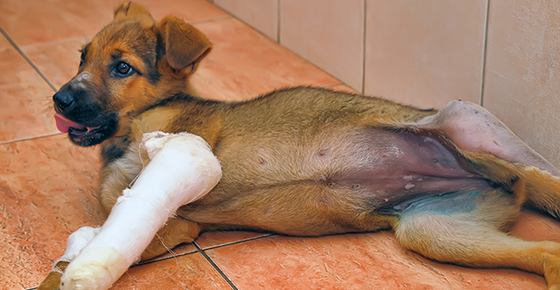
Image of a puppy with a broken leg in a cast.

Puppies are happy and full of energy, running, wrestling, and playing so much that we often wish we had that much energy! But when that puppy is not happy, when it is lethargic and limping, then a visit to the veterinarian is in order. There are several orthopedic diseases that affect young dogs.

Osteochondrosis (OCD) is one of the more common juvenile orthopedic disorders. This is a problem that has an unknown cause but results in a disturbance of an area of cartilage and the underlying bone. This may cause limping, or it may progress to the point where the puppy is non weight bearing if the chip of cartilage and bone breaks off and starts floating around in the joint. Shoulders are the most commonly affected joint (75% of cases), but it can also affect the elbow, knee, or hock. This is a disease of large breed, older puppies. Males are twice as likely to be affected than females. Surgery is usually required.

Panosteitis is another common orthopedic disorder of puppies. This also has an unknown cause, but here the problem is edema inside of the long bones where the bone marrow lies. A hallmark of this disease is called shifting leg lameness, because different legs can be affected at different times. The puppy may be limping on the right front leg this month, then two months later be limping on the left rear leg. Older, large breed puppies are affected, but here males are four times more likely to be affected than females. Treatment is pain control and anti-inflammatory medications. The good news is there are no long term adverse effects of this disease, and eventually the disease just disappears.

Legg-Perthes disease is another orthopedic disease of older puppies, but this time small breeds are more likely to be affected, and females and males are equally affected. For an unknown reason, there is a disruption of blood flow to the head of the femur (thigh bone) which causes the death of some bone cells. When x-rays are taken, this bone in the hip looks like it is dissolving. These bony changes cause pain, and the treatment is a very successful surgery called a femoral head ostectomy (FHO). This removes the whole femoral head and the dog creates a false hip joint.

Elbow dysplasia is becoming more common. This is a syndrome of large breed, older puppies. There are actually a number of problems that can occur in the elbow, and any one or a combination can lead to the arthritis that we call elbow dysplasia. OCD as we discussed before can occur in the elbow. Ununited anconeal process (UAP) and fragmented medial coronoid process (FCP) are other developmental problems. All these disorders require surgery or a debilitating arthritis is likely to occur.

Hypertrophic osteodystrophy (HOD) is a very rare disease of large breed puppies, usually two to eight months of age. The puppy will be lethargic, painful, and may have a fever. The ends of the affected long bones will have a characteristic pattern on an x-ray. These puppies may recover fully, may recover but with some deformities, or may die from the disease.

There are a number of other, less frequently seen, diseases that can cause limping in puppies: Lyme disease, Anaplasmosis, meningitis, and immune- mediated polyarthritis. But undoubtedly, the most common cause of lameness in puppies is, of course, trauma, as puppies can be wild and crazy!

References:
www.veterinarysurgerycenter.com
www.stvetspecialists.com

  • Pet Health
    • Chronic Conditions
    • Digestive and Oral Health
    • Diseases and Viruses
    • Pests and Parasites
    • Orthopedics
  • Today's Veterinarian
  • Choosing Your Pet
    • Finding Your Pet
    • Cats
    • Dogs
    • Exotics
      • Amphibians
      • Birds
      • Reptiles
        • Lizards
        • Turtles
    • Small Mammals
      • Ferrets
      • Rabbits
      • Domesticated Animals
        • Prairie Dogs
      • Pocket Pets
        • Chinchillas
        • Guinea Pigs
        • Hamsters
        • Hedgehogs
        • Rats
    • Livestock
      • Cows
      • Donkeys, Horses & Mules
      • Goats
      • Pigs
      • Poultry
      • Sheep
  • Living With Your Pet
    • Bringing Your Pet Home
    • Children and Pets
    • Providing Care
    • Travel
    • Saying Goodbye
  • Newsletter Library
    • Cats
    • Tips for Pet Owners
    • Behavior & Training
    • Fleas & Parasites
    • Keeping Pets Healthy
    • Recognizing Illness
    • Nutrition & Food
    • Pet Dangers
    • Seasonal Topics
    • Visiting the Vet
    • Equine
    • Newsletter Archive
      • Fun with Pets
      • Unbelievable Pets
  • Video Newsroom
    • Health Topics
    • Technology and Science
    • Other Interests
  • Newsletter Library
  • Client Survey
  • Pets4Kids
No Health Form settings found. Please configure it.

Featured Links

Click to find out more

  • Online Forms

    Our patient forms are available online so they can be completed in the convenience of your own home or office.
  • Instagram

    Follow Us on Instagram

  • Facebook

    Follow us on Facebook!

Office Hours

Our Regular Schedule

Monday:

9:00 am-4:00 pm

Tuesday:

9:00 am-4:00 pm

Wednesday:

9:00 am-4:00 pm

Thursday:

9:00 am-4:00 pm

Friday:

9:00 am-3:00 pm

Saturday:

9:00 am-12:00 pm

Sunday:

Closed

Location

Find us on the map

Testimonials

Read What Our Clients Say

  • "For every emergency or standard procedure, Warner Center is my vet of choice. Dr. Jackson and the staff have been amazing through the years. They are especially understanding of show dogs and responsible breeders. My only wish is for longer hours but they can only do so much. Thank you Warner Center! :)"
    Shauna S. / Woodland Hills, CA

Featured Articles

Read about interesting topics

  • March Newsletter: How to Keep Your Cat Safe When Outdoors

    Wondering how your cat can safely spend time outdoors? ...

    Read More
  • March Newsletter: How to Choose Safe Blankets for Pets

    Do you know how to pick a safe blanket for your pet? ...

    Read More
  • February Newsletter: How to Reduce Dental Anxiety in Pets

    Does your pet hate toothbrushing? These tips could reduce dental anxiety. ...

    Read More
  • February Newsletter: How to Safely Change Your Cat’s Food

    Buying a new food for your cat? Find out how to switch foods safely. ...

    Read More
  • January Newsletter: Signs Your Pet Needs a Wellness Exam

    Does your pet need a wellness exam? ...

    Read More
  • January Newsletter: How Your Veterinarian Can Help If Your Pet Ingests Something Toxic

    Has your pet eaten something it shouldn't have? Find out how your vet can help. ...

    Read More
  • December Newsletter: Signs Your Pet Needs a Professional Cleaning

    Do you know when your pet needs a professional cleaning? ...

    Read More
  • December Newsletter: Simple Ways to Keep Your Home Flea-Free for Your Pet’s Well-being

    Never want to see another flea again? Try these tips for a flea-free home. ...

    Read More
  • November Newsletter: The Importance of Bloodwork for Your Pet’s Health

    Wondering if your pet really needs bloodwork? Find out the benefits of blood tests for your furry friend. ...

    Read More
  • November Newsletter: Turkey Day Tips for Pet Owners

    Don't forget about your pet when making Turkey Day preparations. ...

    Read More

Newsletter Signup

Sign up for more articles

Error!

    Connect With Us

    • Copyright © 2026 MH Sub I, LLC dba iMatrix.
    • Admin Log In
    • Site Map